Fill out the form below and our team will get back to you within 24 hours
Discover what makes us different
Clients average a 200% lift in organic traffic, with some accounts closer to 350%.
We target the commercial keywords that put your business on page one of Google.
Half a decade of South African search campaigns behind every strategy we build.
Google Premier Partner status, verified and maintained since 2022.
Here's what sets us apart from the competition
Find answers to common questions
Key technical work includes improving site speed and render performance, implementing structured data and canonicalization, fixing crawl and index issues, and deploying server-side tracking and clean sitemaps tailored to Shopify or WooCommerce setups.
Accurate measurement uses GA4, Google Tag Manager, server-side tracking, and cohort or MER analyses to link organic sessions to revenue while accounting for assisted conversions and cross-channel attribution.
Timeline varies with competition and technical debt but measurable improvements are commonly seen in 3-12 months; early technical fixes and targeting low-competition, high-intent pages can yield faster, incremental wins while longer-term content and authority work compounds over time.
SEO should feed keyword intent and high-converting landing pages into paid campaigns while CRO testing optimizes those pages for higher conversion rates, creating a system where attribution and data flow inform budget and creative decisions for profit-focused growth.
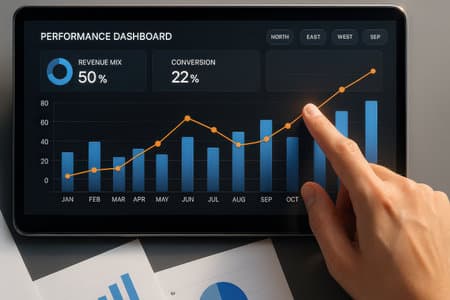
SEO drives revenue by targeting high-intent queries, improving landing-page conversion rates, and reducing acquisition cost over time; technical and content work increases qualified organic traffic that converts into repeat customers and predictable revenue streams.
In This Article
Revenue-first SEO
Technical foundation
Measure and attribute
eCommerce SEO services are built to increase qualified organic traffic, improve funnel conversion rates, and lift revenue per visitor - not just pageviews. In practice, these services combine technical fixes, content strategy, on-page optimisation, and measurement systems so search visibility directly maps to sales growth. Below we unpack the components, the stages of impact, and what to expect for US-based Shopify, WooCommerce, and B2B storefronts.
eCommerce SEO services map keywords and content to funnel stages so organic traffic converts higher at every step.
Conversion tracking diagram (simplified)

Organic Search --> Landing Page (TOF/MOF/BOF) --> Add to Cart --> Checkout --> Purchase
               \--> On-site CRO tests --> Improved CTAs/UX --> Higher conversion rate
               \--> Email & Retargeting (from organic lists) --> Increased repeat purchase
To align SEO to revenue, teams map keywords to specific landing pages and track each page’s contribution to sales. That measurement depends on proper analytics setup (GA4, server-side tracking) and clean attribution so organic sessions are credited accurately - especially important for US stores running multi-channel paid media.
Technical SEO work often precedes content scale. Fixing crawl errors, implementing pagination, ensuring canonical tags, and adding structured data reduce leakage and improve how product pages appear in search. You can learn how Prebo Digital structures cross-channel performance systems on our services overview and see agency-level approach on the homepage.
| Technical Task | Why it matters for sales |
|---|---|
| Indexability & crawl budget | Ensures high-value SKUs are discoverable and ranked quickly. |
| Structured data (Product, Reviews) | Improves SERP CTR and rich results, increasing qualified visits. |
| Mobile Core Web Vitals | Better mobile UX reduces bounce and increases mobile conversion rate. |
Quick note: for US eCommerce sites, shipping, returns, and tax messaging are common conversion blockers - address them in page content and structured data to reduce checkout abandonment.
When planning an SEO roadmap, teams set measurable KPIs tied to revenue: organic revenue, conversion rate from organic sessions, average order value ($), and assisted conversions. Those metrics guide whether efforts focus on content scale, technical fixes, or CRO experiments.
A structured eCommerce SEO engagement follows Strategy → Build → Test → Measure → Scale. Strategy defines which SKUs and categories to prioritise based on margin and search demand. Build covers on-page templates, canonical rules, and content briefs. Test includes CRO and A/B experiments for headline, image, and CTA variations. Measure requires server-side tracking and clear attribution models so organic value flows into revenue reports.
Accurate measurement is critical. For US eCommerce stores, this means configuring GA4 with enhanced eCommerce events, implementing server-side tagging via Google Tag Manager, and reconciling platform-reported conversions with enhanced attribution models. Without this, organic sessions may be under- or over-attributed when users interact with paid media, email, and social channels.
| Measurement Area | Implementation |
|---|---|
| Server-side tracking | Reduces ad-blocker loss and improves conversion attribution. |
| Enhanced eCommerce events | Captures product list views, adds, and purchases for revenue attribution. |
Consider a mid-size Shopify store with $20 average order value and seasonal paid media spend. A focused SEO program might prioritise 50 high-margin SKUs, implement structured product schema, and launch 8 category content pieces. Over 6-12 months this can increase organic transactions by a measurable percentage; exact uplift varies by vertical and competition. Because SEO is cumulative, the emphasis is on sustainable revenue growth and improved customer lifetime value rather than short-term traffic spikes.
Integrating SEO with CRO and paid media is essential. Organic pages that perform well are efficient scale candidates for paid campaigns. Conversely, paid creative that proves conversion concepts can be adapted into SEO content templates. If you want to understand agency-level processes and long-term retainers, see how Prebo Digital organises strategy and reporting on our about page and learn about engagement models on the contact page.
When evaluating vendors, ask for examples of how they tied organic efforts to revenue, details on analytics ownership, and examples of past funnel improvements. Good partners will show a roadmap that balances technical work, content production, and CRO experiments with measurable revenue KPIs.
Here's what sets us apart
Don't just take our word for it
Keep reading
Speak with our SEO specialists to boost your rankings. Free comprehensive SEO audit (worth R2,500).
Get Free SEO Audit