Fill out the form below and our team will get back to you within 24 hours
Discover what makes us different
Clients average a 200% lift in organic traffic, with some accounts closer to 350%.
We target the commercial keywords that put your business on page one of Google.
Half a decade of South African search campaigns behind every strategy we build.
Google Premier Partner status, verified and maintained since 2022.
Here's what sets us apart from the competition
Find answers to common questions
Key technical work includes improving site speed and render performance, implementing structured data and canonicalization, fixing crawl and index issues, and deploying server-side tracking and clean sitemaps tailored to Shopify or WooCommerce setups.
Accurate measurement uses GA4, Google Tag Manager, server-side tracking, and cohort or MER analyses to link organic sessions to revenue while accounting for assisted conversions and cross-channel attribution.
Timeline varies with competition and technical debt but measurable improvements are commonly seen in 3-12 months; early technical fixes and targeting low-competition, high-intent pages can yield faster, incremental wins while longer-term content and authority work compounds over time.
SEO should feed keyword intent and high-converting landing pages into paid campaigns while CRO testing optimizes those pages for higher conversion rates, creating a system where attribution and data flow inform budget and creative decisions for profit-focused growth.
SEO drives revenue by targeting high-intent queries, improving landing-page conversion rates, and reducing acquisition cost over time; technical and content work increases qualified organic traffic that converts into repeat customers and predictable revenue streams.
In This Article
Map link equity
Template & automate
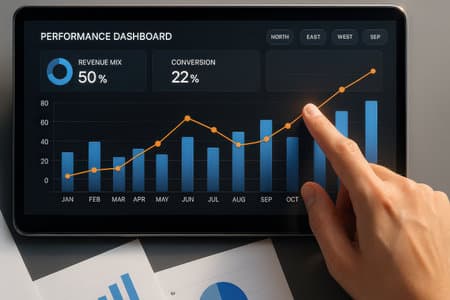
Measure revenue impact
An advanced internal linking strategy is about more than passing PageRank. For SEO agencies working with US-based eCommerce and B2B clients, internal links shape the crawl budget, clarify keyword intent across funnels, and improve attribution for conversion-focused campaigns. Use this guide to design an internal linking system that supports revenue goals, not just ranking signals.
Start with a content inventory and a link graph export from your crawler (Screaming Frog, Sitebulb, or an internal tool). Label pages by funnel stage (TOF, MOF, BOF) and revenue relevance (high, medium, low). This labelling informs which pages become link "sinks" that receive concentrated internal equity (typically BOF product or service pages).
| Funnel Stage | Typical Page Types | Linking Objective |
|---|---|---|
| TOF | Blog posts, industry guides, awareness pages | Cast wide topical nets and funnel internal links to MOF |
| MOF | Category pages, comparison pages, downloadable resources | Refine intent and send qualified visitors to BOF |
| BOF | Product pages, service detail, pricing, contact/demo | Close conversion and collect revenue-focused attribution |
An effective strategy uses contextual anchor text and a limited number of high-value internal links from TOF and MOF pages pointing to BOF pages. Track these clicks with GA4 and server-side events so internal links also feed your attribution models.
Pro tip: Combine internal links with structured data (Product, FAQ, Breadcrumb) to boost how search engines interpret page purpose, then validate changes with a staging crawl before wide rollout.
For agencies that want a systems view, see Prebo Digital's services overview for how linking fits into wider growth systems: Services overview. If you need to align linking strategies with broader site strategy, our homepage outlines our approach to performance-driven SEO and analytics: Prebo Digital homepage.
Translate the map into repeatable templates. Create internal link templates for blog posts, category pages, and knowledge-base articles that specify: target BOF anchors, preferred anchor text variations, link depth limits, and tracking attributes. Where possible, automate link insertion for recurring patterns (e.g., related products, category calls-to-action) while preserving editorial control.
Example 1 - Shopify store (US): a TOF guide about seasonal trends should include 2-3 contextual links: one to a category MOF page, one to a best-sellers MOF, and one to a BOF product with a UTM-free server-side link event. Example 2 - B2B SaaS (US): documentation pages can link to pricing and demo request pages using descriptive anchor text and no indexable tag conflicts to preserve BOF visibility.
When reporting to US founders and growth teams, show both rank movement and revenue impact (e.g., incremental $X in attributable organic revenue, where $ figures are estimates based on tracked conversions and average order value). These figures should be framed as estimates or ranges where appropriate.
Cycle through Strategy → Build → Test → Scale → Report. Quarterly audits should re-evaluate link sinks, update templates, and retire low-performing links. For agencies wanting to align internal linking with broader service delivery, reference Prebo Digital's about page for how we combine analytics, CRO, and development into a structured framework: About Prebo Digital. For implementation logistics or to route complex changes, use the contact page as an internal reference for client handoffs: Contact page.
Here's what sets us apart
Don't just take our word for it
Keep reading
Speak with our SEO specialists to boost your rankings. Free comprehensive SEO audit (worth R2,500).
Get Free SEO Audit